 Changellyexchange
Changellyexchange fixed rates require the quoted deposit before the payment deadline
Changellyexchange fixed rates lock the conversion rate at order creation, provided the service receives the specified deposit within the order's payment window. The website's standard funding window is 15-20 minutes, depending on the input currency. The incoming transfer must appear on the blockchain before that deadline, so a withdrawal request alone does not establish timely payment. Read the order's timer and expected input amount before sending. Confirmation delays can extend the exchange beyond the funding window.
Funds Ready Before Rate Selection
Fixed-rate mode fits a transfer that you can fund with the stated amount on the specified network before its countdown expires. The prerequisite is an available balance that your wallet or sending platform can actually transfer. If a sending platform has not released a withdrawal, creating an order starts the funding timer before the payment is ready. Prepare the receiving address, refund details, and sending balance before confirming the quote. This preparation matters because the exchange order controls its own deadline, while the sending platform controls when it submits your withdrawal.
Floating-rate mode allows the payout estimate to change with market conditions and provides a longer funding window. The choice therefore concerns both transfer readiness and whether you can accept a changing conversion amount.
Input Amount, Payout Amount, and Address Roles
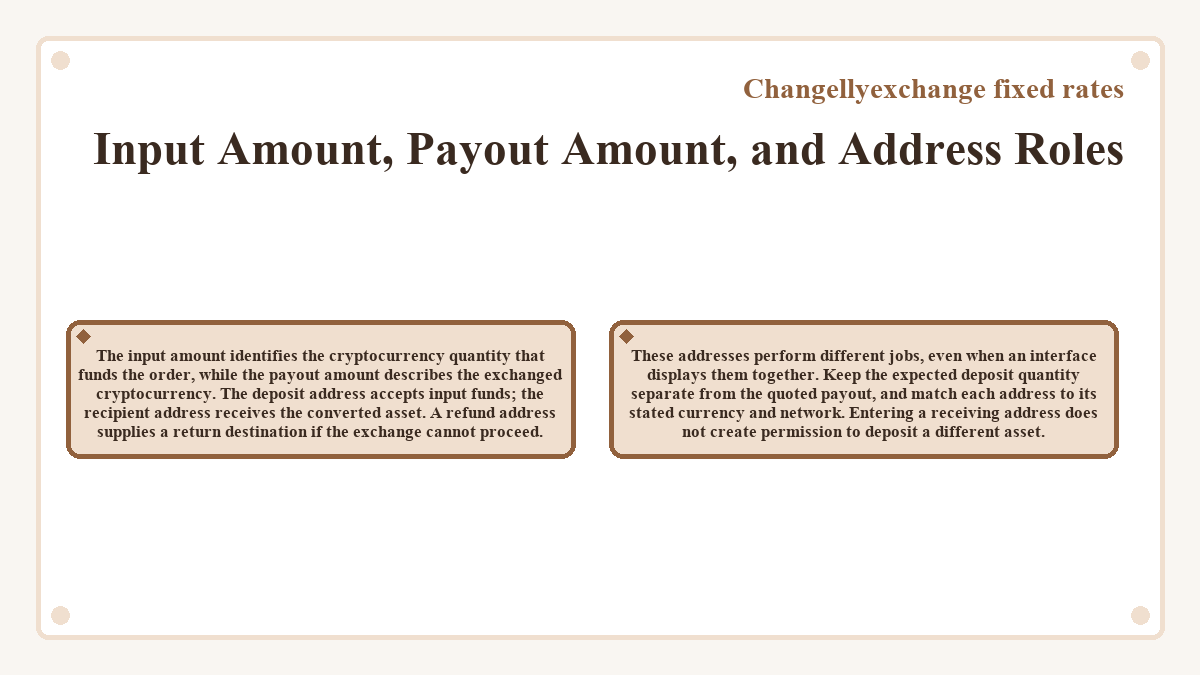
The input amount identifies the cryptocurrency quantity that funds the order, while the payout amount describes the exchanged cryptocurrency. The deposit address accepts input funds; the recipient address receives the converted asset. A refund address supplies a return destination if the exchange cannot proceed. These addresses perform different jobs, even when an interface displays them together. Keep the expected deposit quantity separate from the quoted payout, and match each address to its stated currency and network. Entering a receiving address does not create permission to deposit a different asset.
When Does the Fixed-Rate Payment Window Start?
The website starts the fixed-rate payment window when you confirm the order. The input currency determines whether the standard window allows 15 or 20 minutes. That interval concerns the incoming payment.
The Order's Own Cutoff
The payment instructions show the time available for that particular order. Use their countdown or expiry time to determine the applicable cutoff. Time that passes while you arrange a withdrawal consumes the funding window.
Appearance on the Blockchain
The incoming transfer must appear on the blockchain before the deadline. A sending platform can acknowledge a withdrawal request before the transfer reaches that stage. Its internal debit or approval notice therefore cannot establish that the fixed order has received payment. Compare the sending transaction record with the exchange's payment status when assessing a delay.
The Amount That Reaches the Deposit Address
Deposit matching uses the amount that the exchange receives, which can differ from the quantity entered into a withdrawal form. A fixed-rate exchange requires the received input amount to match the amount specified for the order. Where the sending service deducts a withdrawal fee from the entered quantity, the delivered deposit falls below that quantity. Check how the sender applies its fee before submitting payment. Keep that outgoing charge separate from any network fee shown for the eventual payout, because they affect different sides of the swap.
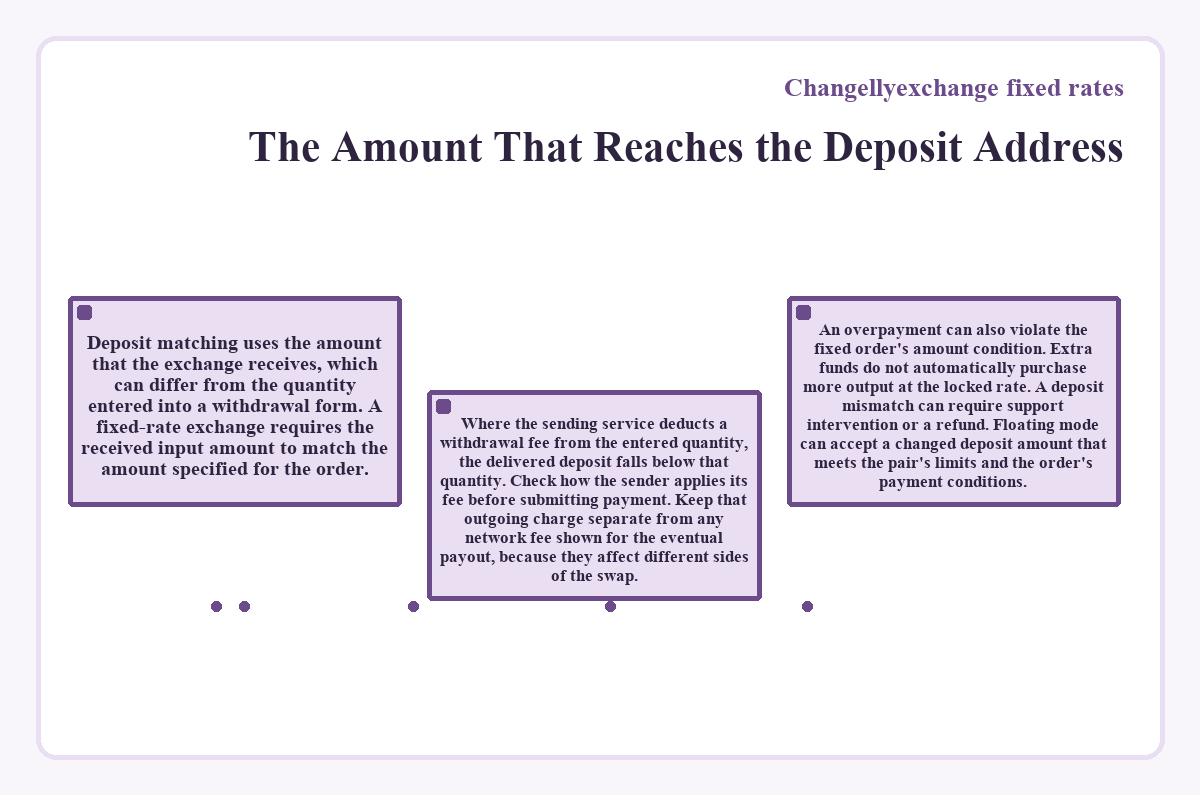
An overpayment can also violate the fixed order's amount condition. Extra funds do not automatically purchase more output at the locked rate. A deposit mismatch can require support intervention or a refund. Floating mode can accept a changed deposit amount that meets the pair's limits and the order's payment conditions.
Network Selection and Payment Identification
The selected network and any required payment identifier determine whether the service can recognize the deposit and associate it with the fixed order.
The Network in the Order
The payment must use the network specified for the selected input asset. Address formats can overlap across networks, so an address that passes a format check does not establish compatibility. A transfer on the wrong network can require difficult recovery or prove unrecoverable.
A Required Memo or Tag
Some deposit instructions include a memo, message, or destination tag alongside the address. Supply the exact additional value when the order requires it. A missing or incorrect identifier prevents automatic processing even when funds reach the address. Support then needs to identify the payment manually.
Quote Expiry in API-Based Orders
An API v2 rate estimate has an expiry that governs order creation, while a created order has its own payment deadline. The estimate supplies a rate identifier and
expiredAt;
createFixTransaction
returns
payTill
after creating the order. An expired rate identifier cannot create a fixed transaction. Once creation succeeds, the payment deadline governs funding.
The Quoted Payout After Fees
A fixed-rate quote incorporates an exchange charge that can vary between quotes, and the payout network fee affects the receiving amount. Review the transaction details before confirming the exchange. Compare the quoted cryptocurrency quantity after the displayed deductions, keeping the same input amount and network when comparing modes. A difference between fixed and floating quotations can exist before any subsequent market movement, because their pricing conditions differ.
In API v2,
amountExpectedTo
represents the payout before deduction of
networkFee.
The network fee uses payout-currency units. Subtracting it gives the net amount under that response's definitions. An interface that already displays the net receiving amount does not require another deduction.
Final payout network charges can differ from their estimates during a fixed-rate exchange. The locked conversion rate does not make that estimate a fixed network charge.
What Happens If the Deposit Misses the Deadline?
A missed payment deadline removes the assurance of automatic execution under the original fixed quote, and a sent deposit can need manual handling. A valid refund destination remains necessary if the service must return the funds. Establish that destination before funding an order.
An Order Without a Deposit
An unpaid fixed order can expire without exchanging funds. Let it expire before creating another fixed order, and use the new order's payment instructions.
A Transfer Already Sent
A payment to an expired deposit address needs support review. The expired exchange order does not reverse the blockchain transfer or move its funds into a newly created order. The terms allow support to process a late fixed-rate deposit manually at the originally confirmed rate when market conditions permit. If the exchange cannot proceed, the service refunds recoverable input funds less applicable fees. Do not resend to that address to try to restart its timer.
For API-based orders, transaction records include
canPush
and
canRefund
indicators for a stopped exchange. These describe available handling possibilities. They do not report that an exchange or refund has finished. The original quote alone cannot establish the amount that a manual resolution will deliver; obtain the proposed handling terms for that deposit.
Refund Availability
A refund requires funds that the service can recover and a suitable return address. Support handles refund cases manually, and recovery costs or network fees can reduce the returned amount. A deposit that cannot cover the return network fee may be nonrefundable. A payment on the wrong network can present a separate recovery problem. The fixed order's timer does not determine a universal refund arrival time, and an expired status alone does not prove that the service has sent a refund.
Conversion Modes and Refund Outcomes
Fixed and floating modes determine the terms of an exchange; a refund returns deposited funds after an unsuccessful exchange when recovery permits it. The amount received follows a different basis in each case. A refund is a recovery outcome, so its availability does not extend the expired quote's payment window.
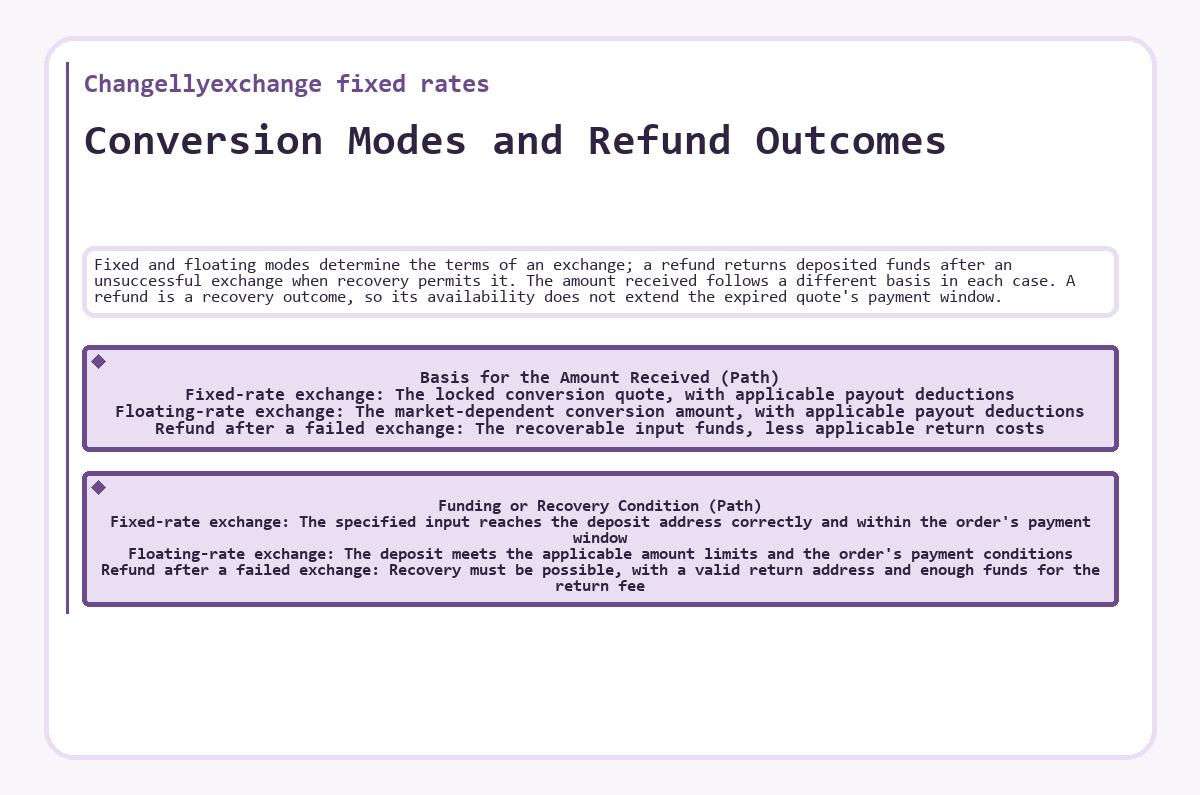
| Path | Basis for the Amount Received | Funding or Recovery Condition |
|---|---|---|
| Fixed-rate exchange | The locked conversion quote, with applicable payout deductions | The specified input reaches the deposit address correctly and within the order's payment window |
| Floating-rate exchange | The market-dependent conversion amount, with applicable payout deductions | The deposit meets the applicable amount limits and the order's payment conditions |
| Refund after a failed exchange | The recoverable input funds, less applicable return costs | Recovery must be possible, with a valid return address and enough funds for the return fee |
Payment Recognition and Later Delays
The Confirming status means the service has received the input and is waiting for the blockchain confirmations needed to continue. The incoming currency determines those requirements. Confirmation waiting can extend total exchange time beyond the original payment window. An order awaiting confirmations therefore presents a different condition from an unpaid order that has expired. Keep the deposit record available when investigating the stage that is pending. A payout transfer has its own transaction record and network progress; a deposit hash establishes information about the incoming transfer.
A Hold status can reflect identity verification or another compliance requirement. Selecting a fixed rate does not exempt the exchange from that review. Trading-partner problems can also delay processing after funding. For API-based orders,
finished
reports that the service successfully sent the coins to the recipient address. The receiving wallet or platform may still apply its own confirmation requirements before displaying an available balance.
Amount Limits Behind an Available Fixed Quote
A fixed quote requires an amount within the permitted range for the selected pair and rate mode. The minimum must cover network costs and the exchangeable market lot; the maximum also depends on the mode. Check the limits that accompany the intended exchange before committing a deposit. Pair availability and limits can change, so a previous quotation does not establish what another fixed order will accept. An amount outside the permitted range can prevent quote or order creation before the payment timer ever starts.
Practical questions about Changellyexchange fixed rates
Can a Short fixed-rate Deposit Be Completed With a Second Transfer?
Sending the missing amount later does not automatically complete a short fixed-rate deposit. Contact support about the original payment. Another transfer to the same address can require manual handling, because the deposit address belongs to a single order and is non-reusable. The second payment does not establish that the first deposit met the fixed quote's amount requirement.
Will Replacing the Deposit Transaction With a higher-fee Transaction Keep the Fixed Order Valid?
A replacement transaction can trigger address-reuse handling once the service has attached the original transaction hash to the order. This includes a fee replacement that supersedes the original unconfirmed transfer. A higher fee alone does not preserve the order's automatic processing. Contact support about the existing payment before attempting that change.
Which Cryptocurrency Must the Refund Address Accept for a fixed-rate Order?
The refund address must accept the input cryptocurrency that you sent for the exchange. The payout recipient serves a different purpose and accepts the converted cryptocurrency. Match the refund destination to the input network, and include an additional identifier if that receiving destination requires one. API v2 has separate refund-address and refund-identifier fields.
How Do I Describe an Expired fixed-rate Payment in a Private Support Request?
Provide the exchange's order identifier, the deposit transaction hash, and a description of the timing problem directly to support. Include a screenshot of the order or payment details if it helps explain the discrepancy. Keep account information and transaction details out of public posts. The exchange identifier locates the service's order; the blockchain hash identifies the separate incoming transfer.
Does a Better Market Rate Allow a Refund After a Fixed Swap Finishes?
The service does not refund a completed fixed-rate exchange simply because a later quote offers a better rate. Review the fixed quotation before funding the order. The refund process concerns unsuccessful exchanges and recoverable deposits, with different conditions from changing a completed conversion.
Can API v2 Calculate a Fixed Quote From the Desired Payout Amount?
API v2 fixed-rate estimation accepts either an input amount or a desired payout amount, with exactly one supplied. The corresponding parameters are amountFrom and amountTo. A payout-based request still requires funding the input cryptocurrency quantity returned for the order. Account for the payout network fee when interpreting the quoted output, and keep that quantity separate from the deposit amount.
Why Did the API Reject a fixed-rate Identifier Before Its Expiry?
The API rejects a fixed-rate identifier that an earlier order-creation request already used. Expiry is not the only invalidation condition. A repeated request can therefore fail after an earlier request created an order. Establish whether that creation succeeded before requesting another quote, and check the existing order's status and payment deadline if it did.