 Changellyexchange
Changellyexchange checks identity documents when a swap enters compliance review
Changellyexchange requires identity verification when its risk screening places a crypto swap on hold. You submit a valid identity document and the face images or video that the verification process requests. Some cases also require records explaining where the exchanged funds came from. KYC means Know Your Customer, while AML means anti-money laundering and covers the wider compliance review. Uploading files starts their assessment, and a successful identity check does not necessarily resolve every transaction concern. The entry point depends on whether you started the exchange through an account, as a guest, or through a partner integration.
Compliance Holds and Exchange Processing
A risk flag can suspend the exchange while the service checks identity, ownership, or fund origin. The service may also restrict an associated account pending verification. A confirmed blockchain deposit establishes that funds reached an address; it does not establish compliance approval. The hold therefore changes when the deposited assets can move through the exchange. Screening identifies cases that need examination and can lead to additional information requests. A hold alone does not tell you which document will resolve the issue or whether reviewers have reached a final decision.
A fixed-rate selection leaves compliance checks in place. The quoted price terms do not establish that deposited assets have passed those checks.
Review Requirements and Document Validity
Identity verification requires a government-issued photo document accepted for the issuing country. Passports, national ID cards, driving licences, and residence permits may qualify when the verification form offers them. Sumsub performs the technical identity checks. The exchange sets the required documents and makes its own compliance decisions.
| Review Parameter | Required Evidence | When It Applies | Who Handles the Check |
|---|---|---|---|
| Identity Document | Valid government-issued photo ID | Accepted type for the issuing country | The exchange sets types; Sumsub checks documents |
| ID Validity | At least one month remaining at submission | Identity-document submission | The verification process checks expiry |
| Face Evidence | Requested photograph or video | Identity match and any requested liveness check | Sumsub performs the comparison |
| Fund Origin | Records explaining acquisition | An additional compliance request | The security team assesses sufficiency |
Where Do You Submit Documents for a Held Swap?
Document submission begins through the verification option attached to the held order, or through the link that the compliance team provides. Confirm the verification destination through your existing account or established support conversation before uploading identity files.
Account-Based Orders
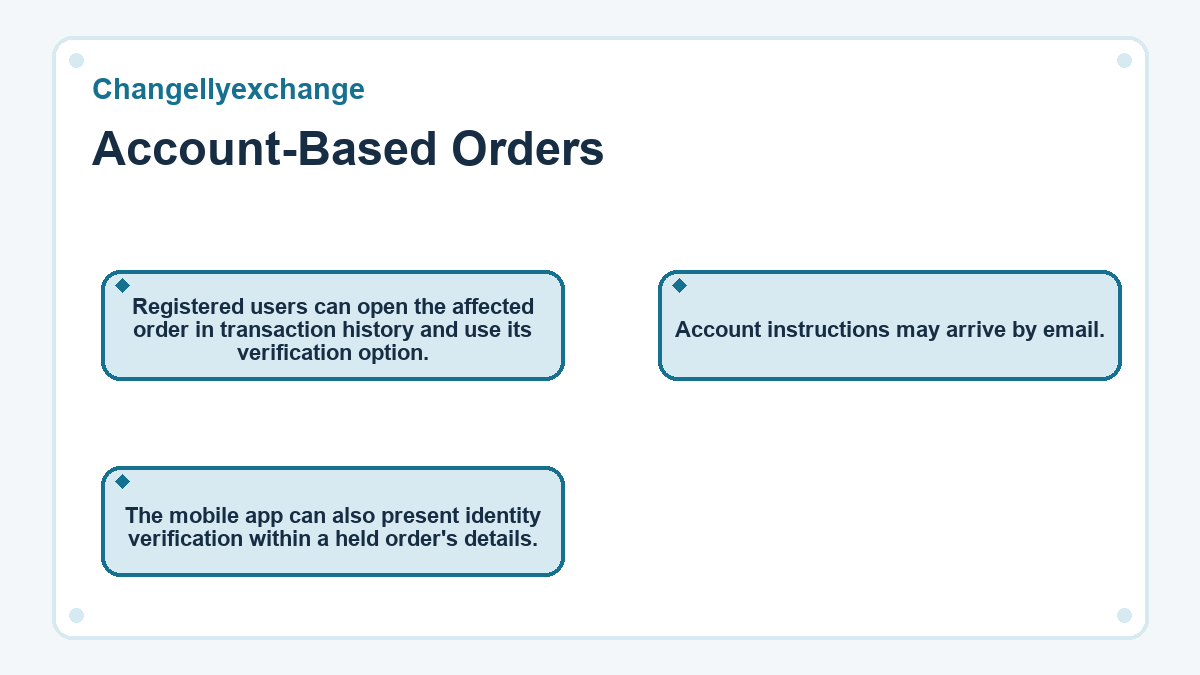
Registered users can open the affected order in transaction history and use its verification option. Account instructions may arrive by email. The mobile app can also present identity verification within a held order's details.
Guest Website Orders
A guest website order can display a KYC submission link when verification becomes necessary. If you left that screen without completing the application, contact the compliance team through the service's support channel.
Partner and Guest App Orders
An unregistered exchange through a partner integration or the app requires contact with the compliance team for a verification link. Keep the exchange identifier available when discussing the held order.
Identity Photos and Live Face Checks
Clear original images let the verifier read the document and compare its portrait with the applicant. Enter personal details as they appear on the ID. The form may request additional identifying information, including date of birth and residential address. Those fields support customer identification; they do not replace the document image.
Document Capture
Photograph the full document with all required pages or sides visible. Keep text legible and avoid glare, cropping, filters, or digital alterations. The verifier does not accept screenshots as identity-document images. Uploading the same side twice cannot substitute for a missing reverse side.
Face Capture and Camera Access
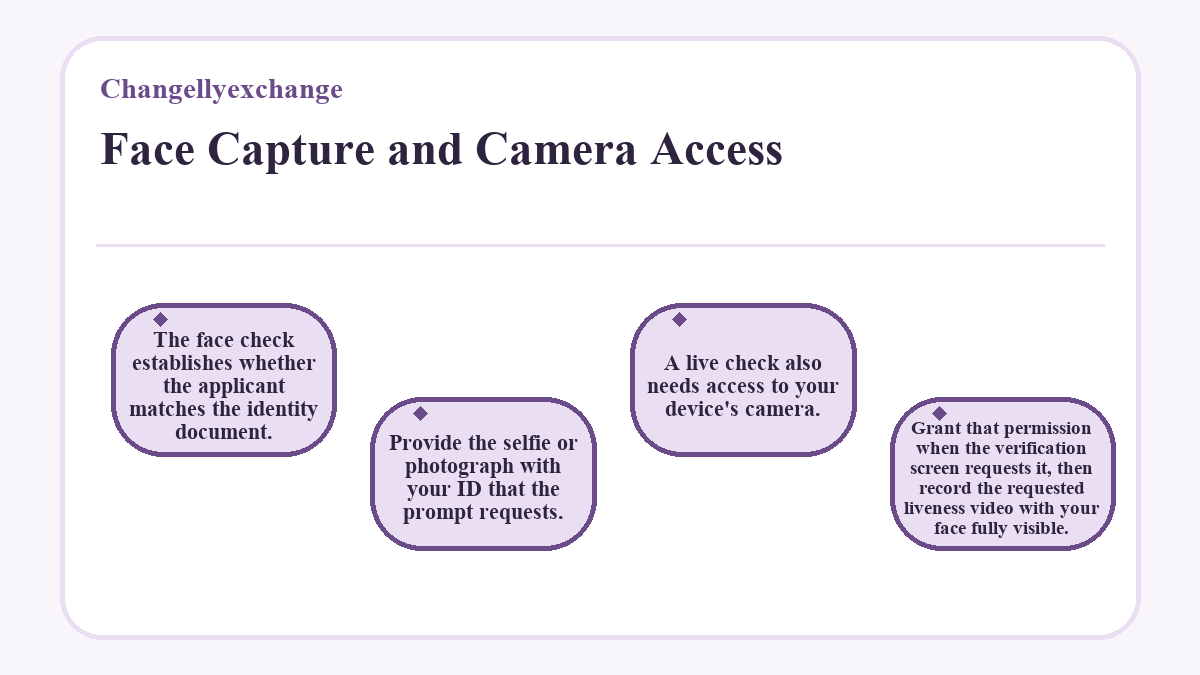
The face check establishes whether the applicant matches the identity document. Provide the selfie or photograph with your ID that the prompt requests. A live check also needs access to your device's camera. Grant that permission when the verification screen requests it, then record the requested liveness video with your face fully visible.
Source-of-Funds Records
A source-of-funds request asks how you obtained the assets that you sent for the exchange. The compliance team may require records proving the origin of those funds. Identity approval alone does not answer that question. Match the explanation to the requested transaction history, and retain the ownership details and dates that make each record understandable.
Purchase and Trading Records
Exchange account history, cryptocurrency seller receipts, and relevant bank statements can document acquisition. A bank record needs to show the purchase that your explanation describes. An unrelated balance screenshot shows an amount, but it may leave the acquisition unexplained.
Direct Transfers and Mining Records
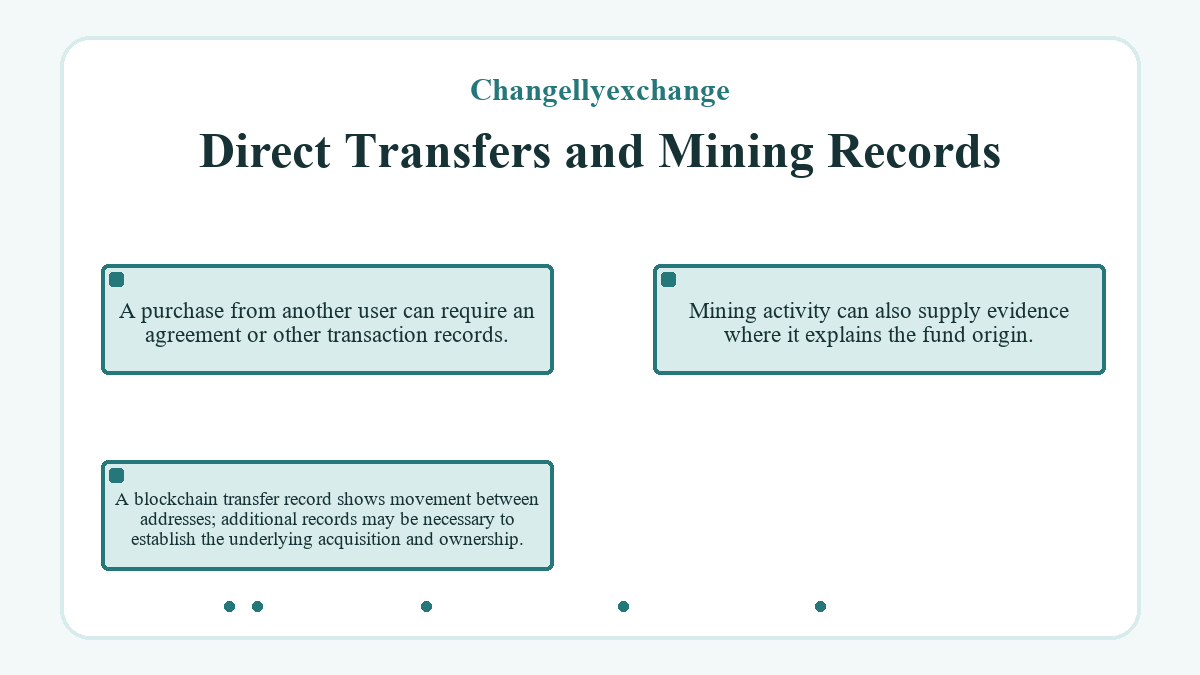
A purchase from another user can require an agreement or other transaction records. Mining activity can also supply evidence where it explains the fund origin. A blockchain transfer record shows movement between addresses; additional records may be necessary to establish the underlying acquisition and ownership.
Does Successful Identity Verification Release the Swap?
Successful identity verification does not automatically close a separate review of the transaction or the origin of its funds. The upload interface can acknowledge submission before reviewers finish their assessment. A verification-complete screen can still leave you waiting for the security team's message. Read that message for confirmation of clearance or any further request. The application status and the exchange status describe different parts of the process.
Compliance clearance allows processing to resume where the order remains eligible. Actual payout and wallet receipt remain separate exchange events.
Personal Data and Review Access
Verification sends sensitive identity material to a specialist provider and links that material to the exchange review. The service can share personal information with contracted providers and, where permitted or required, relevant authorities. That arrangement limits anonymity for the submitted transaction. Data protection measures reduce exposure, but they do not erase the sensitivity of an ID image or a facial recording.
Impersonation attempts can imitate verification requests.
Rejected Documents and Unresolved Holds
A rejection requires a response to the actual reason, such as unreadable photos, missing document information, or mismatched personal details. Retaking a blurred image can address image quality. An expired ID needs an accepted replacement. For an unsupported document type, confirm which alternatives the service accepts. A residency restriction concerns service eligibility, and improving the photograph does not resolve that restriction.
A request for more fund-origin evidence calls for the missing acquisition records, not another copy of the same identity document.
Extended compliance investigations can involve several parties and can last weeks or months. A quick automated image check does not set the deadline for that investigation. Ask the security team whether the remaining issue concerns identity, ownership, fund origin, or service eligibility.
Declining a required check can leave the exchange unresolved because the service may refuse completion before verification. Request a case-specific explanation of any available refund process and applicable fees. A refund request alone does not establish that the service has approved or sent the return payment.
Popular questions about Changellyexchange
How Long Does the Initial Identity Check Take?
The usual guidance for identity verification is within 24 hours, although security reasons can extend the review. This estimate concerns the ID check, not the release of every held transaction. Additional fund-origin questions or an investigation involving other parties can keep an order pending after the initial document review.
Can an Expired Verification Link Be Renewed?
The security or compliance team can provide a replacement for an expired verification link. Request a fresh link through the existing case conversation and identify the affected exchange. Link expiry concerns access to the verification application; it does not cancel the deposit or establish a refund decision.
Do Identity Documents in Another Language Need Translation?
A non-English identity document does not automatically require translation. The verifier accepts many languages, and requirements can depend on the script and the applicable verification rules. For a document in an unsupported language, the submission must include the original ID and a notarized English translation. Confirm the requirement before paying for a translation, because changing the interface language does not change document acceptance.
Will Deleting My Account Remove the KYC Records?
Account deletion does not automatically erase KYC records. The service retains identification information for five years after account closure and identity-verification records for five years after their creation. Legal retention requirements can limit a deletion request. Closing an account does not make every record's retention period end together.
Does a Small Swap Automatically Avoid KYC?
A low exchange amount does not establish that a swap is exempt from KYC. Risk-based checks may apply to particular users, addresses, and transactions. The amount limits shown in a quote describe exchange eligibility, not a waiver of identity checks. A verification request attached to the order remains a separate requirement.
Who Handles Refund Decisions After a KYC Hold?
The exchange handles refund decisions for a held swap, while Sumsub supplies identity-verification technology. Sumsub does not control exchange deposits or payouts. Contact the exchange's security or support team about a held deposit or refund request. An identity-provider support response cannot itself authorize movement of the deposited assets.